This is the first action project for my STEAM class called “Urban Planning”. In this unit we learned about the strength of triangles and how to calculate them. We then used our knowledge to understand the structure of buildings and bridges, which led us into our action project. In this action project we had to create a design for a bridge and go through the process of creating it. After we finished making our bridges we had to test them. Each bridge had to hold at least ten pounds and the strongest bridge got extra credit.
Showing posts with label Steam. Show all posts
Showing posts with label Steam. Show all posts
Thursday, April 26, 2018

Friday, October 27, 2017
Hubba Bubble
In this second project for my design and engineering class we created a bike design for a certain profile that we were given. We had to create multiple designs that led up to a final model, and explain our choices included in our design. In this unit we learned about the function of bikes, and what makes them important. The different math concepts including gear ratios, graphing, etc were all used in this action project.
The radius of our wheel is 13 inches which makes the diameter 26 inches. We can use this information to figure out the circumference by multiplying the diameter by pi (3.14) which gets us 81.68 inches. Using both the circumference and the distance we can figure out the number of rotations her wheels make on the way to school. To do this we divide 4 miles (253440 in.) by 81.68 inches which gets us 3102.84 rotations.

Energy
During this project me and my partner struggled with multiple issues. For example when we made a model of our bike, we noticed that the 3D printer had ended up detaching the wheels from the frame of the bike. In order to fix this we had to use a glue gun and glue the wheels on to the frame. The biggest thing I took out of this action project is actually learning the process of making a bike. I thought this was cool because there are so many different bikes, and we were able to use our knowledge from this unit and put it all together in order to solve a common problem.
Persona/Needs
When designing a product it is best to use a persona. Our persona was a girl named Vanessa. She lives 4 miles away from her school. She is 17 and has a little brother that she has to take to day care every day before school. Her house is by the United Center and Lake Shore with the streets full of pot holes, while the "L" runs down her commute to school. After taking in all this information, we took not of the needs that Vanessa had. This included safety, security, and two seats for her and her brother.
Labels/Benefits
Our bike Is called the "Hubba Bubble" which is a bike meant for a safe and reliable experience. It has features including a cushioned seat, a protective bubble around the child seat, balloon tires, and protective measures in order to make sure that the Hubba Bubble does not get stolen. We put in a protective bubble around the child's seat because we didn't want the child passenger to get hurt if the driver gets in an accident. The bubble surrounding the car seat is sound proof so the noise of the train or other noises don't disturb the child. We also added balloon tires on the bike so when Vanessa bikes over potholes she can ride as smoothly as possible. One of the protective measures we added was a folding aspect that lets the user use the bike itself as a lock. In order to enforce that it does not get stolen we also added a touch id to the bike so the user is the only one who can ride it.
 |
| VD (2017) "Labled Sketch" |
Speed, Wheel Size, and Wheel Rotations
Vanessa lives 4 miles from her school and it takes her 22 minutes to got straight there. Using this information we can find the speed she bike in both mph and m/s. If 4/22 is equal to x/60 we have to multiply 4 by 60 to get 240. Then we use that number and divide it by 22 which gets us 10.9 mph. After this we can convert it into m/s by multiple 10.9 by 1609.34 (1 mile) which gets us 17541.806. Afterwards we divide by 3600 (1 hour) and get 4.87 m/s. The radius of our wheel is 13 inches which makes the diameter 26 inches. We can use this information to figure out the circumference by multiplying the diameter by pi (3.14) which gets us 81.68 inches. Using both the circumference and the distance we can figure out the number of rotations her wheels make on the way to school. To do this we divide 4 miles (253440 in.) by 81.68 inches which gets us 3102.84 rotations.
Below are some of the calculations that are involved in making the ellipses included in the Geogrebra Bike Design.

 |
| MJF (2017) "Geogabra Bike" |
While using this bike Vanessa demonstrates both kinetic and potential energy. Since kinetic energy comes from movement, the speed she rides demonstrates it perfectly. Right before she first presses her foot down on the pedal, she demonstrates potential energy since no other energy has been released yet.
Scale/Gears
Another thing we looked at is the gears that would be used on the bike. Vanessa isn't looking for a fast bike so we know hat there should be a larger gear in the front and a smaller gear in the back. For the smaller gear we decided that it had to have 16 teeth, while the larger gear has 44 teeth.The scale we used on our bike and model was 1:13. This means that 1 inch on our model would be 13 inches on the final product.
 |
| VD (2017) Hubba Bubble Journey |
Reason to Believe
Our product is perfect for any Chicagoan that has to travel with a child and is concerned for their safety. The Hubba Bubble protects the child from both physical harm and loud noses so they are not disturbed. Our lock system keeps anyone from stealing the bike so the user can be worry free about being able o use it. While we talked o a couple of bikers about what they like about their bikes, one of them said "It is a simple bike and very comfortable. Because it is simple, very few things can go wrong." We took note of this and made a safe bike that can be used by anyone.
During this project me and my partner struggled with multiple issues. For example when we made a model of our bike, we noticed that the 3D printer had ended up detaching the wheels from the frame of the bike. In order to fix this we had to use a glue gun and glue the wheels on to the frame. The biggest thing I took out of this action project is actually learning the process of making a bike. I thought this was cool because there are so many different bikes, and we were able to use our knowledge from this unit and put it all together in order to solve a common problem.
Wednesday, September 27, 2017
The Handy Can, Can
In my first action project for my class called “Design and engineering” we learned about different types of ways to figure out how to solve solutions for gardening tools in order to help the elderly. What made this action project different was that I had to work with a partner (MN). In this class we learned about simple machines and physics concepts which helped us with this action project.
While being the designers of this tool there were a lot of variables we had to think about. For example, while designing our watering can we had to think about empathy and how others will feel about the product. Since we based this design on the elderly, we had to think about to solve average problems that we thought would benefit for them. Some of the research that helped us figure out common problems was using the tool ourselves and seeing what problems we could find first hand.
The dimensions of the watering can's base are 8 in by 12 in by 6 in. In order to find the volume we had to multiply the length, width and height to the can. We got 8*12*6= 576 in³ which is equal to 319.1688 us fl oz. In order to find the surface area I had to add the area of each side. The equation we got was 2(8*12+8*6+6*12)=432.
While being the designers of this tool there were a lot of variables we had to think about. For example, while designing our watering can we had to think about empathy and how others will feel about the product. Since we based this design on the elderly, we had to think about to solve average problems that we thought would benefit for them. Some of the research that helped us figure out common problems was using the tool ourselves and seeing what problems we could find first hand.
During our research we went to home depot to see a watering can in action. We noticed certain aspects of the cans there that were useful like an angled handle to make it easier to pour, and others that were not so useful like super long spouts. While we were talking with one of the staff about our ideas and tools he said "Sometimes the product made of cheaper material works better for a specific task". This made us think about the material we wanted to use and we went with plastic in order to make the product less heavy while also not having to worry about money cost.
In the image below you will see a sketch of our Handy Can design. This sketch explains the different upgrades we made to the average watering can and what we decided to keep. Look for some of these specific qualities from our watering can.
In the image below you will see a sketch of our Handy Can design. This sketch explains the different upgrades we made to the average watering can and what we decided to keep. Look for some of these specific qualities from our watering can.
- Switchable Spouts- In order to switch from watering a narrow area to a wide area.
- Box Shape- Has a wider bottom surface to spread the weight of the water inside.
- Hand Grips- In order to reduce the stress on your hand and wrist while holding it.
- Angled Handle- Helps the user get a better angle to pour with less work.
- Tripod- Meant for the watering can to sit on while pouring to prevent holding a heavy can.
- Measurements for water- Small clear strips in the watering can to let the user measure the water.
 | |
|
Below is a story board of how this product would be used. This story board shows what happens to the watering can from when it starts in the garden shed and ends with a fully grown plant. Below that is a sketch of the forces used when using the Handy Can. The force we chose to talk about is the user's hand when they angle the spout towards the ground and pours water on it.
 | |
|
 | |
|
 | |
|
The biggest struggle I had while making this project was getting the scanned photos of my product on to the blog. Since the pictures on my blog were the wrong type of file I needed to put the file on another website and screenshotted the pictures. I was eventually able to work it out by learning how to edit the pictures in order to make them look nice on the blog. The biggest thing I took out of this action project was empathy because it applies to most things in life.
Works Cited
Home Depot Employee. Personal Interview. 20 Sept 2017
Friday, June 2, 2017
Patient profile
This is my third and last action project for my class called “Cure”. In this unit we learned about different types of ways to figure out probability. We also learned about different foods, vitamins, and minerals and what they do to help the human body. For this action project, I created a fictional patient profile and I wrote down all the medical history I could inside of it. I also figured out the probability of my patient getting diabetes. My favorite part of making this action project was making the patient profile. The biggest problem I had while making this project was finding the information, because the project required an extreme amount of research in order to create my fictional patient profile. I eventually was able to work on it all night and come up with enough information on the patient to be able to finish my AP.
Monday, May 22, 2017
How to Betray Tooth Decay
This is my second action project for my class called “Cure”. In this unit we learned about different types of drugs, what differs between both over the counter and prescription, and we learned about remedies and saw how each affected each other.. For this action project, I created a medicine box with a symptom that had three different ways of treatment on it to demonstrate my knowledge of medicine. My favorite part of making this action project was physically making the box because doing all the research took a lot longer than I wanted it to. The biggest problem I had while making this project was finding the information, because the symptom I chose was not really good for the type of questions I had, and there wasn’t really a lot of information or history on it. I eventually was able to come up with enough information on the transplant to be able to finish my AP.
Friday, April 28, 2017
Penis Transplant
This is my first action project for my class called “Cure”. In this unit we learned about different types of surgeries, the cells involved in some of those surgeries, and how we use them to help people in the world today compared to how we used to use surgery. For this action project, I created a “Prezi” about a surgery of my choice and explained different aspects of why you would get the surgery and how it’s done. My favorite part of making this action project was telling people about the surgery because the surgery I chose made people squirm when I explained how it was done. The biggest problem I had while making this project was finding some of the information because the surgery I chose was pretty recent and there wasn’t really a lot of information or history on it. I eventually was able to come up with enough information on the transplant to be able to finish my AP.
Sunday, February 26, 2017
Ebola Strikes Like A Cobra
This is my final action project for my class called Disease. In this unit called “Cure”, we learned about different types of ways a disease can spread, and how we can slow the way it spreads down. For this action project, I wrote an article about a past outbreak in the world and I talk about ways it spread and where it can spread to in the future. My favorite part of making this action project was using the newspaper generator because it really made me feel like a reporter. The biggest problem I had while making this project was trying to embed my article into my project. The problem I had was that there was no way I could publish my pdf to the internet which meant that I couldn’t embed it anywhere. I eventually was able to remember that I could use a website called Issu and put my pdf in there and that it would work.
Centers for Disease Control and Prevention. Centers for Disease Control and Prevention, 22 Sept. 2015. Web. 26 Feb. 2017.
"Ebola." Centers for Disease Control and Prevention. Centers for Disease Control and Prevention, 22 Sept. 2015. Web. 26 Feb. 2017.
"Ebola Fast Facts." CNN. Cable News Network, n.d. Web. 26 Feb. 2017.
"Signs and Symptoms." Centers for Disease Control and Prevention. Centers for Disease Control and Prevention, 02 Nov. 2014. Web. 26 Feb. 2017.
Works Cited
"Ebola." Centers for Disease Control and Prevention. Centers for Disease Control and Prevention, 22 Sept. 2015. Web. 26 Feb. 2017.
"Ebola Fast Facts." CNN. Cable News Network, n.d. Web. 26 Feb. 2017.
"Signs and Symptoms." Centers for Disease Control and Prevention. Centers for Disease Control and Prevention, 02 Nov. 2014. Web. 26 Feb. 2017.
Thursday, February 9, 2017
A Conclusion for Delusion
This is my second action project for my Disease class. In the unit called “Mind”, we learned about the brain and how it is affected by mental disorders, as well as how it affects the body. For this action project I made a lesson where I had to convey how it feels to have the mental disorder I chose. Then I put it into action and video taped the lesson to post on my blog. My favorite part of making this action project was seeing all the different lesson plans because they were all really good. The biggest problem I had while making this project that I would’ve changed was figuring out how to get my classmates to feel the emotions I wanted them to. The problem I had was that it was hard for me to know how people who didn’t know anything about my mental disorder to understand what I wanted them to feel. I eventually was able to work with other people who weren’t in the class to try it out before I did my presentation and figured out what to do.
Below is a video of my presentation on this disorder.
Works Cited
"Psychology Today." Delusional Disorder | Psychology Today. N.p., n.d. Web. 09 Feb. 2017.
Kiran, Chandra, and Suprakash Chaudhury. "Understanding delusions." Industrial Psychiatry Journal. Medknow Publications, 2009. Web. 09 Feb. 2017.
In this unit I learned from Dr. Royanne that, "mind and body are always connected and affect one another." The disease I chose is called Delusional Disorder. Patients diagnosed with his disorder believe that things that aren't happening are happening. The scientific definition says it is a condition associated with one or more nonbizarre delusions of thinking—such as expressing beliefs that occur in real life such as being poisoned, being stalked, being loved or deceived, or having an illness, provided no other symptoms of schizophrenia are exhibited.
Below is a video of my presentation on this disorder.
Works Cited
Kiran, Chandra, and Suprakash Chaudhury. "Understanding delusions." Industrial Psychiatry Journal. Medknow Publications, 2009. Web. 09 Feb. 2017.
Wpadmin. "23 Fascinating Delusional Disorder Statistics." HRFnd. HRE, 13 Jan. 2015. Web. 09 Feb. 2017.
Friday, January 20, 2017
How to I.D. HIV
This is my first action project for my Disease class. The unit called “Body” was about the different kinds of body systems in the human body and diseases that affect us. For this action project I found a person that I know who has a disease and made a patient profile for them. Then I created a body outline and highlighted the specific parts of the body that are affected by the disease. My favorite part of making this action project was doing the research because disease is an interesting topic to me. For example I don’t normally enjoy researching information in my STEAM classes because it’s hard to remember information in that way, but since this action project was interesting the research came easily. Even though I had fun, the biggest problem I had while making this project was doing the body outline.The problem I had was that it was hard for me to stay still while I was being traced which made me end up having to do multiple outlines, but then I realized that it might be that my partner might be the problem. I switched out my partner with someone who had done this project before and the rest went smoothly from there.
My friend Timothy is a teenager who is well known in school and has a loving family. About a year ago he was infected with HIV. He was used to having a lot of friends and being lucky so he couldn’t imagine anything happening to his life. Before he knew he had HIV, he had already started to experience some of the symptoms of having it. He started coughing a lot and he had multiple high fevers. He already had an idea of what he had so he went to get tested and to see if he had HIV. When he found out he was infected he got really scared because he had gotten it through doing drugs with dirty needles. He didn’t want to tell his parents because he knew that he would get in trouble. When I asked how his parents reacted when they found out he had it he told me,"My parents were extremely mad because I actually told them that I got it from having sex."
My friend Timothy is a teenager who is well known in school and has a loving family. About a year ago he was infected with HIV. He was used to having a lot of friends and being lucky so he couldn’t imagine anything happening to his life. Before he knew he had HIV, he had already started to experience some of the symptoms of having it. He started coughing a lot and he had multiple high fevers. He already had an idea of what he had so he went to get tested and to see if he had HIV. When he found out he was infected he got really scared because he had gotten it through doing drugs with dirty needles. He didn’t want to tell his parents because he knew that he would get in trouble. When I asked how his parents reacted when they found out he had it he told me,"My parents were extremely mad because I actually told them that I got it from having sex."
After taking doses of a drug called Zidovudine to help lessen the symptoms of HIV, he is able to move on from being infected to his old routine of hanging out with friends and family. The dose he was supposed to take was 300 mg orally every 12 hours or 200 mg orally every 8 hours. Zidovudine is not the only way you can fight HIV/AIDS though. There are numerous other drugs and methods that can help reverse the infection. The best way to prevent it though is through protection during intercourse like condoms. Of course another way to help prevent it is by making sure when taking drugs the needle is always a clean new needle. Those are the best ways to prevent any risk factors.
HIV/AIDS
AIDS (acquired immune deficiency syndrome) is a disease that can ruin your immune system by causing multiple symptoms at the same time. AIDS is a symptom from another disease called HIV human immunodeficiency virus. HIV is a disease that also weakens your immune system, but the difference between AIDS and HIV, is that HIV is normally a cause for people infected with it to become infected with numerous other diseases like AIDS. Both of these diseases can be caused in three different ways. The first and most well known way is through sexual intercourse. The second way is through blood to blood contact The final and least known way is through being born with it after the parents had it. Both HIV and AIDS are infectious diseases but they could also be genetic diseases as well.
For my friend his symptoms started in the Respiratory System. At first it was just coughing, but next was hard breathing. His main problem was the coughing because at first he was trying to hide the fact that he was sick, and it was really tough for him to do.
Next was the integumentary system where he got Molluscum contagiosum. Molluscum contagiosum is a symptom that appears on the skin as bumps. For my friend they appeared on his arm, but they could appear anywhere on the body.
It is even possible for AIDS to affect the nervous system. It can cause HIV-associated dementia or AIDS dementia complex which seriously hurt your cognitive skills. They could also impair the memory.
idovudine Dosage Guide with Precautions." Guide with Precautions - Drugs.com. Drugs.com, 6 Aug. 16. Web. 20 Jan. 2017.
"The Effects of HIV/AIDS on Different Systems of the Body." LIVESTRONG.COM. Leaf Group, 24 June 2015. Web. 20 Jan. 2017.
Next was the integumentary system where he got Molluscum contagiosum. Molluscum contagiosum is a symptom that appears on the skin as bumps. For my friend they appeared on his arm, but they could appear anywhere on the body.
It is even possible for AIDS to affect the nervous system. It can cause HIV-associated dementia or AIDS dementia complex which seriously hurt your cognitive skills. They could also impair the memory.
 | |
|
 |
| MJF(2017)"HIV" |
 | |
|
Works Cited
"24 Effects of HIV on the Body." Healthline. Healthline, 22 Oct. 2014. Web. 20 Jan. 2017.
idovudine Dosage Guide with Precautions." Guide with Precautions - Drugs.com. Drugs.com, 6 Aug. 16. Web. 20 Jan. 2017.
"The Effects of HIV/AIDS on Different Systems of the Body." LIVESTRONG.COM. Leaf Group, 24 June 2015. Web. 20 Jan. 2017.
Friday, October 14, 2016
Deceased by Disease
This is my second action project for my population class. This unit was about the evolution of animals and learning how to find data. For this action project I chose ten different cats that I researched and gathered data on them. Then I chose three of those cats and hypothetically put them in a place hey don’t naturally live. I made a video to explain what would happen if I were to put them there. My favorite part of this project was seeing all the cats that I researched as well as their awesome names.The biggest problem I had while making this project was having to work with the video without looking at the script. I ended up putting the script in the slideshow and just use it as subtitles, and I’m happy that it turned out pretty well.
India is a very interesting place, and it’s beaches can be even more interesting. Their beaches contain a large amount of wildlife, and it has an extremely warm climate. The beaches are covered in soft sand, grass, and saltwater. Wildlife in this area includes many predators like sharks, tigers, and especially snakes. For a species to live here they need to be able to fend for themselves against other species, and they need to be able to know how get fresh water. They also need to know what food is good to eat, and how to make a good shelter. Larger animals would thrive in this environment, while smaller animals are more at risk of becoming prey. A large threat for organisms would be insects since they are likely to carry diseases. House cats do not naturally live in this area but I think it would be interesting to see how they would adapt to this possibly harsh environment.
India is a very interesting place, and it’s beaches can be even more interesting. Their beaches contain a large amount of wildlife, and it has an extremely warm climate. The beaches are covered in soft sand, grass, and saltwater. Wildlife in this area includes many predators like sharks, tigers, and especially snakes. For a species to live here they need to be able to fend for themselves against other species, and they need to be able to know how get fresh water. They also need to know what food is good to eat, and how to make a good shelter. Larger animals would thrive in this environment, while smaller animals are more at risk of becoming prey. A large threat for organisms would be insects since they are likely to carry diseases. House cats do not naturally live in this area but I think it would be interesting to see how they would adapt to this possibly harsh environment.
I researched ten different house cats from Paws Chicago and recorded data on them.
Crux- 9.94 lb
Gelada- 7.13 lb
Starburst- 2.24 lb
Hawking- 6 lb
Chorizo- 3 lb
Tzatziki- 4 lb
Fig- 7.56 lb
Cupertino- 3 lb
Roseanne- 14 lb
Jessco- 10.63 lb
Of these ten cats I chose Starburst, Hawking, and Roseanne to be moved from their foster homes to an Indian beach. I chose them because they represent the minimum, median, and maximum weights of my data.
I found the average weight of the ten cats I chose as well as the maximum, minimum and range.
Numbers: 2.24,3,3,4,6,7.13,7.56,9.94,10.63,14
Mean: 6.75
Median: 6.57(rounded)
Mode: 3
Max:14
Min: 2.24
Range: 11.76
After finding the average weight of the cats, I created a “Box and Whiskers” plot to find the lower and upper quartiles.
Lower quartile: 3.25
Median: 6.57
Upper quartile: 9.34
Standard Deviation
data
|
data-mean
|
(data - mean)2
|
2.24
|
-4.51
|
20.3401
|
3
|
-3.75
|
14.0625
|
3
|
-3.75
|
14.0625
|
4
|
-2.75
|
7.5625
|
6
|
-0.75
|
0.5625
|
7.13
|
0.38
|
0.1444
|
7.56
|
0.81
|
0.6561
|
9.94
|
3.19
|
10.1761
|
10.63
|
3.88
|
15.0544
|
14
|
7.25
|
52.5625
|
σ=3.8756
Combination
C(n,r) =
C(10,3) =
10! / (3! (10 - 3)!) =120
Permutation
P(n,r) =
P(10,3) =
10! / (10 - 3)! =720
P(n,r) =
P(10,3) =
10! / (10 - 3)! =720
Works Cited
"Health Information for Travelers to India." Centers for Disease Control and Prevention. Centers for Disease Control and Prevention, 24 May 2016. Web. 14 Oct. 2016.
Only, By Appointment. "Pets Available | PAWS Chicago." PAWS Chicago. Paws, 2016. Web. 14 Oct. 2016.
Thursday, September 22, 2016
Sistrurus catenatus
This is my first action project for my population class. This unit was about the taxonomy of animals and learning how to classify a species. For this action project I chose an animal at the Lincoln Park Zoo, I compared it to other animals, and taxonomized it. The animal I chose was the Massasauga Rattlesnake or Sistrurus catenatus. I also made a collage of the rattlesnake and turned it into a GIF, to help show the taxonomy of the rattlesnake. My favorite part of this project was seeing all the other colleges that other classmates made.The biggest problem I had while making this project was that I broke my toe around the time we started the project and I had a day less to work on it. I ended up working all night to make sure that it would be finished on time, and I think it turned out pretty well.
Underneath I made some statements to compare and contrast using Set Theory language and then translated them into english so it’s easier to understand.
Let R=reptiles, S=Mammals, C=Cold Blooded, M= Massasauga Rattlesnake,L= Lynx, G= Gorilla
M ∈ {R}
Massasauga Rattlesnake is an element of Reptiles
R ∈ {C} ∴ M ∈ {C}
Reptiles are an element of Cold Blooded therefore Massasauga Rattlesnakes are an element of Cold Blooded
∀R:C
Being cold blooded is true for all reptiles
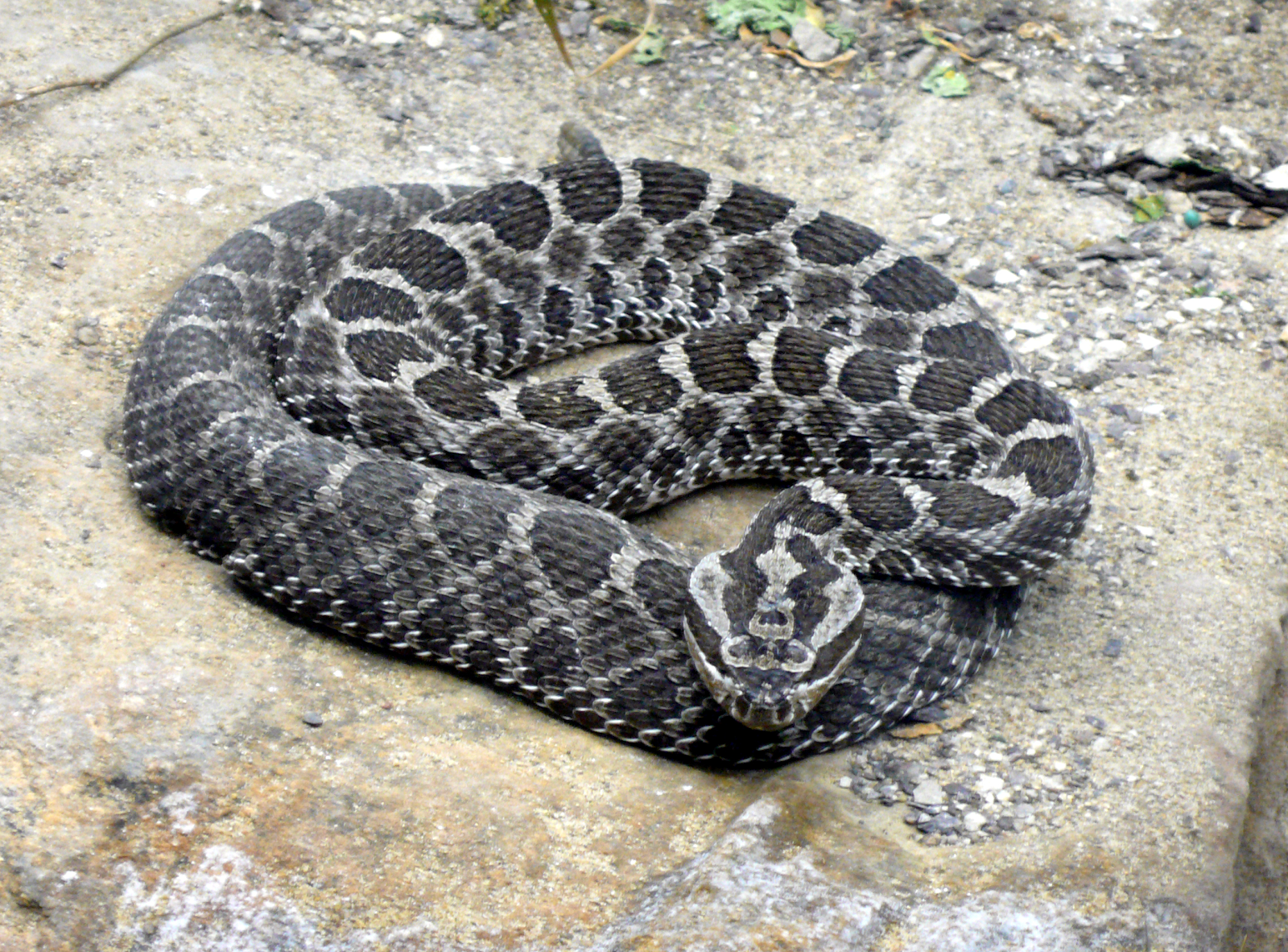 |
| S. catenatus, St. Louis Zoo(2016) |
The animals that I compared to the Rattlesnake was MN's animal (the Eurasian Lynx) and AA's animal (the Gorilla). I noticed that it was easier to compare the Rattlesnake to the Lynx, than it was the Rattlesnake to the Gorilla. I put all the information into a Venn Diagram below.
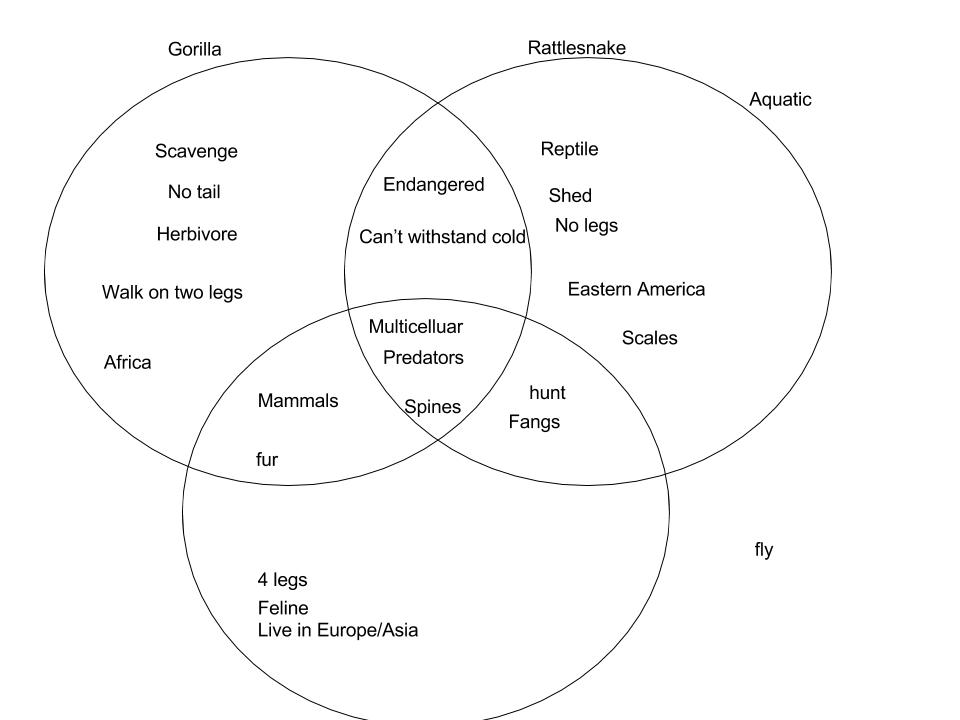 |
Comparison, MJF (2016)
|
Let R=reptiles, S=Mammals, C=Cold Blooded, M= Massasauga Rattlesnake,L= Lynx, G= Gorilla
M ∈ {R}
Massasauga Rattlesnake is an element of Reptiles
R ∈ {C} ∴ M ∈ {C}
Reptiles are an element of Cold Blooded therefore Massasauga Rattlesnakes are an element of Cold Blooded
∀R:C
Being cold blooded is true for all reptiles
|{S}|=2
There are two elements in the set of Mammals
There are two elements in the set of Mammals
P(C) {{R}}
The subset of Cold Blooded is Reptiles
g ∈ Rc∩Cc∩S
Gorilla is an element of not reptiles or coldblooded but is an element of mammals
g ∈ Rc∩Cc∩S
Gorilla is an element of not reptiles or coldblooded but is an element of mammals
Works Cited
Michigan. "You Are HereDNR Wildlife & Habitat Wildlife Species Amphibians & Reptiles." DNR. State Of Michigan, n.d. Web. 26 Sept. 2016.
Arcsin. "Sistrurus Catenatus." Massasauga Classification. Bioweb, n.d. Web. 26 Sept. 2016.
Michigan. "You Are HereDNR Wildlife & Habitat Wildlife Species Amphibians & Reptiles." DNR. State Of Michigan, n.d. Web. 26 Sept. 2016.
Arcsin. "Sistrurus Catenatus." Massasauga Classification. Bioweb, n.d. Web. 26 Sept. 2016.
Saturday, May 28, 2016
GMO's Are Great
This is my third and final action project for my “Food!” class. This unit was about GMO’s (Genetically Modify Organisms) in our food and how they help and mess up our food system. For this action project we chose a side saying whether GMO’s are good or bad and we made an argument to debate on which side is right. I made my Slideshow using google slides and screencastify instead of doing a video of me talking.. My favorite part of this action project was doing a actual debate in class, because it’s always fun being right and having a better argument. The only problem I had while making this project was choosing a side because at first using GMO’s seems morally wrong, but when you look at the facts GMO’s help so many people.

Thursday, May 12, 2016
Making Dough
This is my second action project for my “Food!” class. This unit was about different chemical reactions that occur while cooking or baking, like leaving for example. For this action project we conducted a lab experiment to see what would happen if we were to change the leavening agents in two types of bread, while we kept one the same. I made my document using isuu which is a website that turned my pdf to look pretty good.. My favorite part of this action project was doing the baking, because I don’t ever bake which made me appreciate the project so much more. The only problem I had while making this project was that a classmate forgot to time the yeast bread which may have affected the experiment.
Wednesday, April 20, 2016
Garden of My Dreams
This is my first action project for my “Food!” class. This unit was about different plants and how they interact with each other through symbiosis. For this action project we created some ideas for a garden that we could potentially grow near our houses. I made a drawing of the garden that I could grow where the plants help each other using a diagram I made with Google drawings. My favorite part of this action project was seeing all the different ways you could raise the nitrogen, phosphorus, and potassium level of the soil we were given. The only problem I had while making this project was that I accidentally left my computer charger at my cousin's house, so I had to use one of the school computers. It wouldn’t have been a problem if the school computers were good but the mouse button kept getting stuck therefore making my illustration harder to make.
My garden will be on a flat area of my roof. I would be able to put the bins and tank in any formation or pattern I want because the space that I can use is fairly big. The only major problem that might come up is that there are a lot of pipes up there which lowers the amount of space I could have had.
I have three different sized bins that I could plant my garden in. One is a bin that is 2.7 by 1.7 by 1.7 ft3. I think this container will grow the most vegetables because it has the largest height and the roots of the plants will be able to grow deeper. The other bin I have is a lot shorter but it has a longer width. Its dimensions are 3.8 by 1.7 by .6 ft3. I think the plants in this bin will grow the least because it has the lowest height, and the plants won’t be able to grow their roots. The final container I chose is a glass tank with the dimensions of 2.1 by 1.1 by 1.1 ft3. I have no Idea how the plants will grow in this container but it would be interesting to find out.
My original soil quality had a ph level of 5.0. This is not good because it’s too acidic for some plants. The best way to raise the acidity level would be to add limestone to the soil. The soil also had a nitrogen level of 2 which is about 20 ppm (parts per million). This is a little to low for vegetables so to raise it I would have to add 5 pounds of blood meal per 100 acres and 7 pounds per 100 square ft if I had that much soil. My original potassium level was 2 which is about 400 ppm in the soil. This means I don’t need to add any potassium to my soil because the potassium level is just high enough. My phosphorus level was 3 which is also a perfect amount because it’s just high enough so I don’t have to add anything to it.
I chose the plants I chose because they’re all plants that I like. They also happen to help each other out. When anything of the other plants fall off the mycelium that I would plant to grow the mushrooms would decompose the fallen biomaterial and turn it into nutrients for the other plants to help them grow and it would be a never ending cycle of love.
My garden is actually pretty efficient because of the symbiotic relationships that help the plants grow. In this project I was able learn how to help plants grow each other the way Masanobu Fukuoka did in his book One Straw Revolution.

|
MJF Garden (2016)
Monday, March 21, 2016
Pollution
This is my final action project for my fuel class. This unit was about different ways how pollution is a problem and the ways we can help reverse the process we’ve created. For this action project I looked at the different ways I could stop my own pollution emissions, and how much pollution I give off in a year. I showed one of my actions that I would use to help reverse pollution using a diagram I made with google drawings. My favorite part of this project was seeing how other people in my class gave off pollution compared to the amount I gave off. The only problem I had while making this project was that my computer stop working so I had to finish it on my phone. I eventually got a new computer, and besides that this AP was pretty fun.
Pollution is just contaminants that are put into the earth leading to the harm of the planet. Pollution is released into the atmosphere in many different ways. A common way pollution can occur is through gases that we emit through vehicles. A second way we give off pollution is through making products, because they release gases like CO2 which gets caught in the carbon cycle. Pollution is also created when we don’t compost food. Decomposers can’t break down food when they’re put in landfills because the chemicals in other waste kill the bacteria that should decompose the food.
I release 15.3 tons of carbon per year if I continue to live my life the same way I've been. My annual greenhouse gases are equivalent to about 0.711 garbage trucks of waste recycled instead of land-filled. My annual CO2 emissions could compare to 578 propane cylinders used for home barbecues. To offset the carbon emissions that I give off per yearI have to plant 356 trees. The site used the equation 23.2 lbs C/tree × (44 units CO2 ÷ 12 units C) × 1 metric ton ÷ 2,204.6 lbs = 0.039 metric ton CO2 per urban tree planted. This means that each tree that I plant will take in 23.2 pounds of carbon. Then they divided the molecular weight of carbon dioxide to carbon. After that the website multiplied that with the ratio of 1 metric ton per pound.
I have come up with 3 actions that I could do to help reduce the atmosphere’s carbon ppm (parts per million). My first action to change would be to insulate my house which can reduce the cost of my house’s cooling as low as 90%. That would be great for the atmosphere and my family's wallet. The second way to help reduce the carbon in the earth's atmosphere would be to drive a Tesla electric car, because it gives no CO2 emissions off. A car that uses gas releases 20 pounds of carbon per gallon, and on average 6 tons of carbon is released in a year by a single gas using car. This can also benefit my family specifically because we wouldn’t have to pay for gas which can cost a lot of money. My last idea to reduce the amount of carbon is to travel less, meaning not flying. This would lower my CO2 emissions by 53.3 pounds per air mile, as one air mile produces 53.3 pounds of carbon dioxide. I travel about 1632.14 miles per year so by taking a plane I give off 86993.062 pounds of carbon.

My actions will help reduce the global carbon ppm from 400 to 350 since that is about the amount that is healthy to the earth because they are all more efficient ways of what I do now. I won’t make much of a difference just by myself, but I could influence or inspire people to follow some of my actions which can cause a massive chain reaction of influencing others which would create an astronomical change in the earth's atmosphere’s carbon ppm.
1."GHG Equivalencies Calculator - Calculations and References." EPA. Environmental Protection Agency, 8 Oct. 2015. Web. 18 Mar. 2016.
2."Powerwall." Tesla. 2016. Web. 18 Mar. 2016.
3."First Understand, Then Destroy, Your Home Heating Bill." Mr. Money Mustache.Money Mustache, 2011. Web. 18 Mar. 2016.
M.J.F
3-8-16
Fuel
Saving the World
Pollution is just contaminants that are put into the earth leading to the harm of the planet. Pollution is released into the atmosphere in many different ways. A common way pollution can occur is through gases that we emit through vehicles. A second way we give off pollution is through making products, because they release gases like CO2 which gets caught in the carbon cycle. Pollution is also created when we don’t compost food. Decomposers can’t break down food when they’re put in landfills because the chemicals in other waste kill the bacteria that should decompose the food.
I release 15.3 tons of carbon per year if I continue to live my life the same way I've been. My annual greenhouse gases are equivalent to about 0.711 garbage trucks of waste recycled instead of land-filled. My annual CO2 emissions could compare to 578 propane cylinders used for home barbecues. To offset the carbon emissions that I give off per yearI have to plant 356 trees. The site used the equation 23.2 lbs C/tree × (44 units CO2 ÷ 12 units C) × 1 metric ton ÷ 2,204.6 lbs = 0.039 metric ton CO2 per urban tree planted. This means that each tree that I plant will take in 23.2 pounds of carbon. Then they divided the molecular weight of carbon dioxide to carbon. After that the website multiplied that with the ratio of 1 metric ton per pound.
I have come up with 3 actions that I could do to help reduce the atmosphere’s carbon ppm (parts per million). My first action to change would be to insulate my house which can reduce the cost of my house’s cooling as low as 90%. That would be great for the atmosphere and my family's wallet. The second way to help reduce the carbon in the earth's atmosphere would be to drive a Tesla electric car, because it gives no CO2 emissions off. A car that uses gas releases 20 pounds of carbon per gallon, and on average 6 tons of carbon is released in a year by a single gas using car. This can also benefit my family specifically because we wouldn’t have to pay for gas which can cost a lot of money. My last idea to reduce the amount of carbon is to travel less, meaning not flying. This would lower my CO2 emissions by 53.3 pounds per air mile, as one air mile produces 53.3 pounds of carbon dioxide. I travel about 1632.14 miles per year so by taking a plane I give off 86993.062 pounds of carbon.
MJF (2016) ”Action 3 Diagram”
My actions will help reduce the global carbon ppm from 400 to 350 since that is about the amount that is healthy to the earth because they are all more efficient ways of what I do now. I won’t make much of a difference just by myself, but I could influence or inspire people to follow some of my actions which can cause a massive chain reaction of influencing others which would create an astronomical change in the earth's atmosphere’s carbon ppm.
Works Cited
1."GHG Equivalencies Calculator - Calculations and References." EPA. Environmental Protection Agency, 8 Oct. 2015. Web. 18 Mar. 2016.
2."Powerwall." Tesla. 2016. Web. 18 Mar. 2016.
3."First Understand, Then Destroy, Your Home Heating Bill." Mr. Money Mustache.Money Mustache, 2011. Web. 18 Mar. 2016.
Subscribe to:
Posts (Atom)